
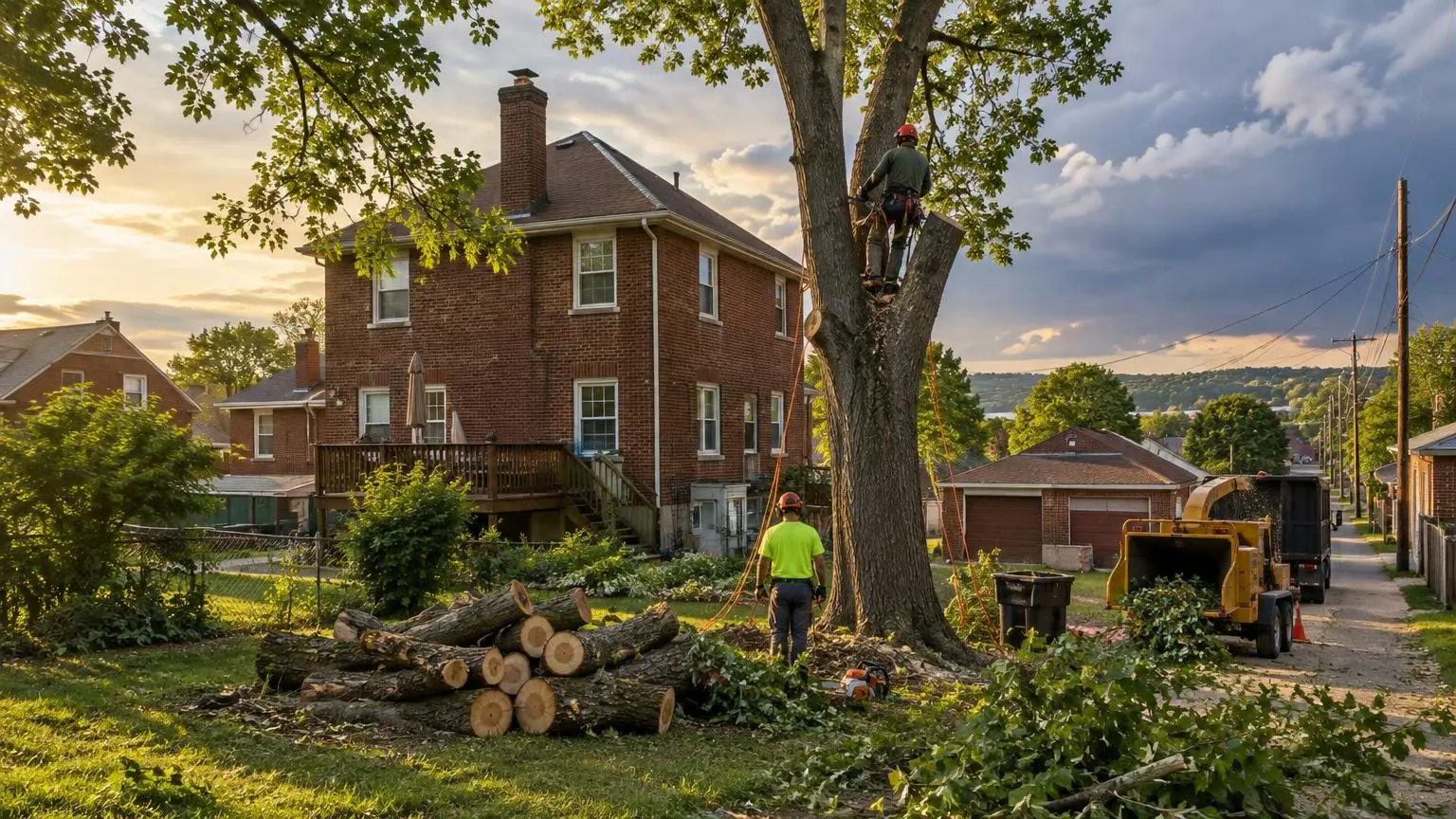
Four communities joined in 1930
Tree Removal in Olivette, MO
Mature neighborhood trees on a city built along an old ridge road.
- We come out and look before we price, anywhere in City of St. Louis and St. Louis County
- Each item on the estimate priced on its own
- We confirm where the wood goes before work begins
A City Along the Ridge
Tree Removal in Olivette often comes down to wind. Olive Road, today's Olive Boulevard, was a ridge road, and the city grew up along that high ground. The area was first settled in the mid-1800s as a farming community along Old Bonhomme Road, which began as an Indian trail, and in 1930 the communities of Central, Tower Hill, Olive and Stratmann combined to incorporate as Olivette. Trees on higher ground and in open yards take the full force of the thunderstorms that cross St. Louis County every spring and summer, and they show it: broken tops, torn limbs and trees that have grown with a permanent lean.
Neighborhood scale
Olivette covers about 2.8 square miles and had 8,504 residents and 3,300 housing units at the 2020 census, or roughly 1,200 homes per square mile. That is more spacious than the inner-ring suburbs to the east, but lots are still small enough that most large trees stand within reach of a house, garage or neighbor's fence. The population peaked at 9,156 in 1970, and many of the city's shade trees were planted in the decades before and after that peak.
Water, parks and big trees
In the 1920s, St. Louis built a water reservoir at Brock's Pond, finished in 1926, and Stacy Park grew around it to become Olivette's largest park. Parks like that, and the wooded edges of older lots, hold many of the city's biggest trees. Homes that back onto green space often have tall trees right at the property line, including ash that have died from emerald ash borer and large oaks with deadwood in the crown.
Signs a windy-site tree needs attention
- A broken or dead top, especially on a tall tree standing alone
- Cracks where large limbs join the trunk
- Branches that have been rubbing and wearing through the bark
- A lean that has changed after a storm
- Heaving or cracking soil on one side of the base
Any of these is a reason to have the tree looked at before the next storm season.
What to expect from us
We come out, look at the tree and its surroundings, and explain the options. For removals near homes, we take the tree down in sections, lower every piece and leave the yard clean. You get a written estimate that spells out the work. Call (314) 668-1571 or send the form. Get a free estimate
Olivette History and Layout
- Formed in 1930. Olivette incorporated in 1930 by combining the communities of Central, Tower Hill, Olive and Stratmann. The name Central came from the Central Plank Road, now Olive Boulevard.
- A ridge road. Olive Road, now Olive Boulevard, was a ridge road, and Old Bonhomme Road began as an Indian trail. The first brick schoolhouse in St. Louis County was built in the 1850s at Price and Old Bonhomme.
- Stacy Park. St. Louis built a water reservoir at Brock's Pond, finished in 1926, and Stacy Park formed around it. It is now Olivette's largest park.
- Housing. The 2020 census counted 8,504 residents and 3,300 housing units, 4.6 percent vacant, on about 2.8 square miles. The population peaked at 9,156 in 1970.
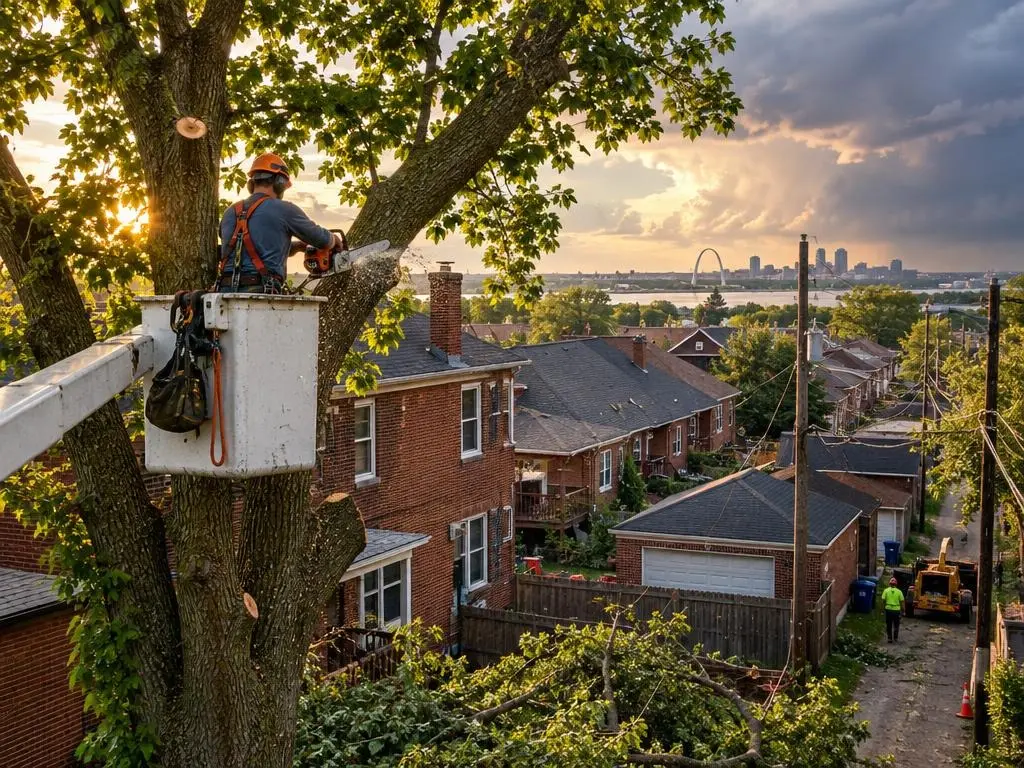
Olivette Questions
Our tree lost its top in a storm. Can it be saved?
Smaller trees sometimes recover with corrective pruning. A large shade tree that loses its top usually regrows a cluster of weakly attached sprouts around a wound that decays over time. In most cases, removal and replanting is the safer long-term answer.
We back up to a park. Who handles trees on the line?
If the trunk is in the park, it belongs to the public owner, and you should contact them about a hazard. If the trunk is on your side, it is your tree. We can help figure out which it is.
How do I know if my tree is too close to the house?
Proximity alone is not the issue; condition is. A sound tree near a house can be pruned for clearance. A tree with decay, a split, dieback or root damage that close to the house should be assessed promptly.
Can you remove a tree in the winter?
Yes. Winter is often a good time: the structure of the tree is easier to see, the lawn and beds are dormant, and the ground may be firmer for equipment.
Will you leave wood chips for my garden beds?
Yes, if you want them. Chips from the brush can be dumped in a spot you choose instead of hauled away. Fresh chips work well as path mulch or around established shrubs; keep them a few inches away from trunks and house siding.
Tree Removal Near Olivette
- Tree Removal in St. Louis, MO
- Tree Removal in Kirkwood, MO
- Tree Removal in University City, MO
- Tree Removal in Clayton, MO
- Tree Removal in Webster Groves, MO
- Tree Removal in Ladue, MO
- Tree Removal in Chesterfield, MO
- Tree Removal in Ballwin, MO
- Tree Removal in Wildwood, MO
- Tree Removal in St. Peters, MO
- Tree Removal in Brentwood, MO
- Tree Removal in Richmond Heights, MO
- Tree Removal in Maplewood, MO
- Tree Removal in Glendale, MO
- Tree Removal in Creve Coeur, MO
- Tree Removal in Town and Country, MO
- Tree Removal in Sunset Hills, MO
- Tree Removal in Crestwood, MO
- Tree Removal in Des Peres, MO
- Tree Removal in Manchester, MO
- Tree Removal in Maryland Heights, MO
- Tree Removal in Bridgeton, MO
- Tree Removal in Florissant, MO
- Tree Removal in St. Charles, MO
- Tree Removal in O'Fallon, MO
- Tree Removal in Arnold, MO
- Tree Removal in Oakville, MO
- Tree Removal in Affton, MO
- Tree Removal in Edwardsville, IL