
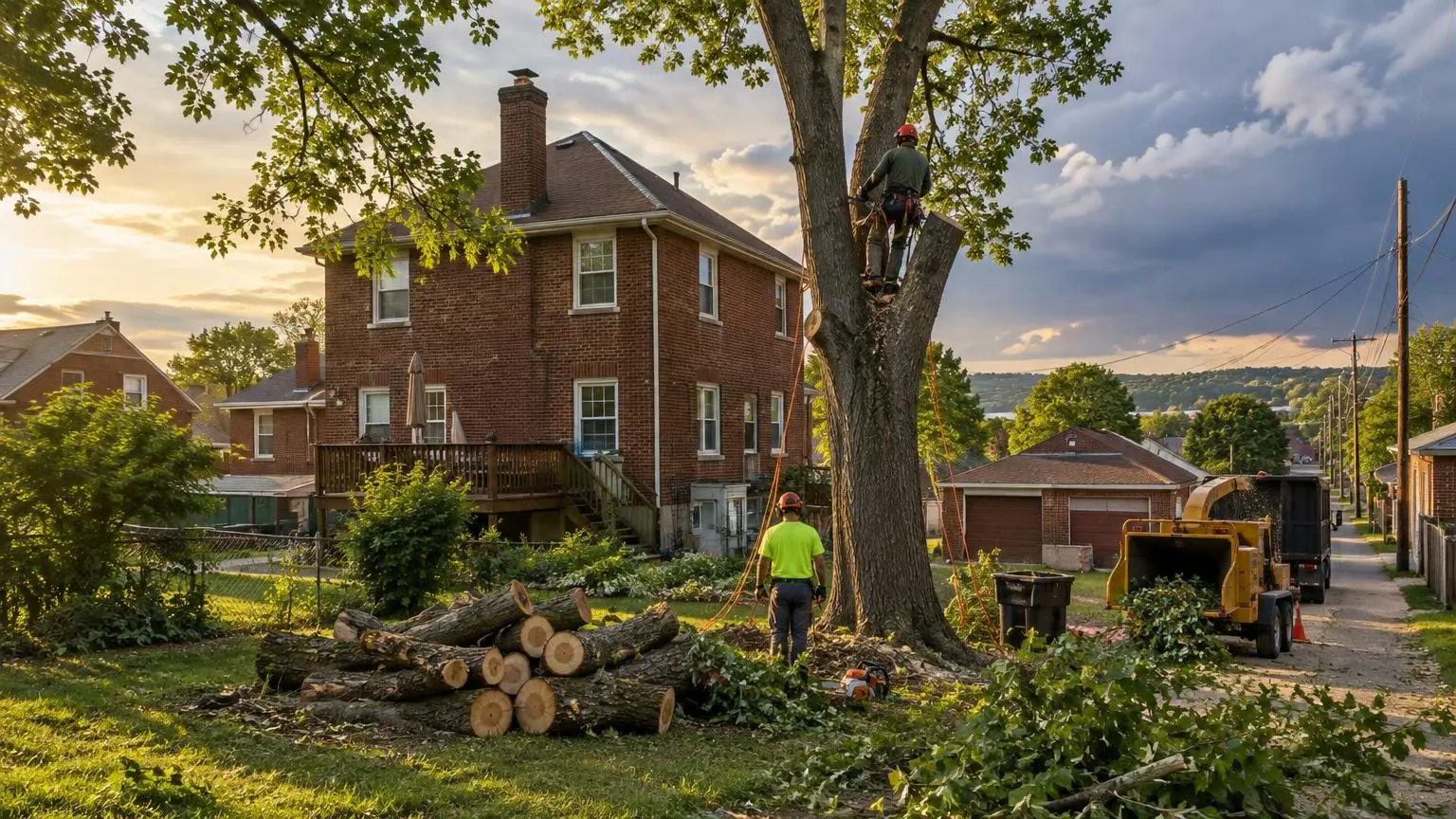
St. Louis County's first emerald ash borer find, August 2015
Tree Removal in Creve Coeur, MO
A decade into the ash borer, plus the everyday removals that come with big suburban yards.
- We come out and look before we price, anywhere in City of St. Louis and St. Louis County
- Each item on the estimate priced on its own
- We confirm where the wood goes before work begins
Ground Zero for Ash Borer in the County
Tree Removal in Creve Coeur has a particular history. In August 2015, St. Louis County Department of Transportation staff reported suspect ash trees near Lindbergh and Schuetz roads. A Missouri Department of Conservation forester found several infested trees, and state and federal agencies confirmed emerald ash borer larvae there. It was the first confirmed infestation in St. Louis County. The beetle had already turned up in St. Charles County and north St. Louis city. Ten years on, most untreated ash in Creve Coeur yards are dead, dying or gone.
Why dead ash are a priority
Ash killed by the borer dries out fast. Within a few years, the wood becomes brittle and branches snap off without warning, sometimes on calm days. Climbing a long-dead ash is risky, so we usually remove them from a lift or rig them from a neighboring tree. The longer one stands, the harder and more expensive it is to take down safely. If you still have ash in the yard, it is worth sorting them into three groups: healthy trees worth treating, trees in decline that should be removed soon, and dead trees that should come out now.
How to spot ash borer damage
The Missouri Department of Conservation points to two telltale marks, and arborists watch for several more:
- S-shaped tunnels under the bark, left by feeding larvae
- D-shaped exit holes where adult beetles emerged
- A thinning crown, dying back from the top
- Woodpecker damage that strips bark in light patches
- Shoots sprouting from the lower trunk
MDC says insecticides work best generally from early May to June. A tree that has already lost much of its crown is usually beyond saving.
A suburb that grew along Olive
Creve Coeur incorporated in 1949 and grew as a stop along Olive Boulevard, then faster after Interstate 270 and U.S. 40 were built. Today it has 18,834 residents and 8,988 housing units across about 10.3 square miles. Its yards are larger than those of the inner suburbs and hold a mix of native oaks and hickories, planted maples and the ash that so many subdivisions relied on. The city's name, French for heartbreak, comes from Creve Coeur Lake, which now lies in neighboring Maryland Heights.
Beyond ash
Other common requests in Creve Coeur include removing storm-damaged oaks, trees crowding houses, and large trees with root damage from driveway or patio work. Call (314) 668-1571 or send the form for a written estimate. Get a free estimate
Creve Coeur Facts
- First county ash borer find. On Aug. 14, 2015, St. Louis County transportation staff reported suspect trees near Lindbergh and Schuetz roads in Creve Coeur. MDC found infested trees, and the Missouri Department of Agriculture and USDA confirmed the larvae, the first find in St. Louis County.
- Treatment window. MDC advises that insecticide treatments for emerald ash borer work best generally from early May to June, when adults are active and larvae are developing, and that some treatments need to start earlier in spring.
- Suburban growth. Creve Coeur incorporated in 1949 and had 18,834 residents and 8,988 housing units in 2020 on about 10.3 square miles. Growth accelerated after I-270 and U.S. 40 were built.
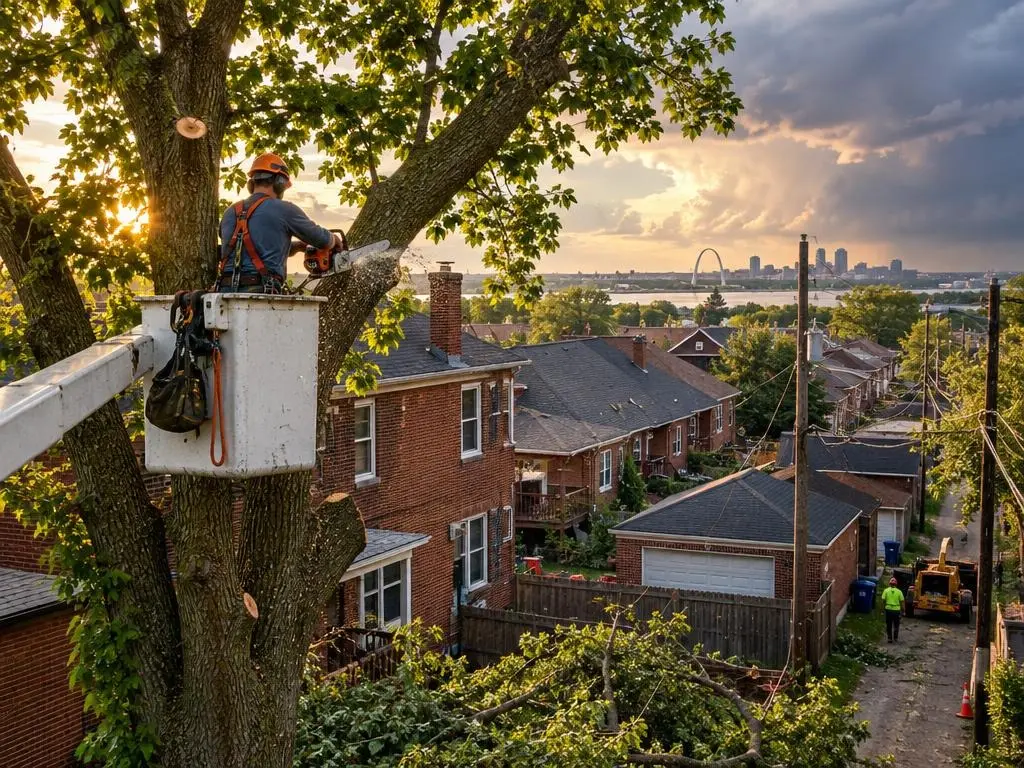
Creve Coeur Questions
Should I treat my ash or have it removed?
It depends on how healthy it is. An ash with a full, healthy crown may be a good candidate for treatment, which has to be repeated every one to three years. One that has lost a large share of its crown, or shows D-shaped exit holes and bark splitting, is usually better removed.
My ash has been dead for years. Is it dangerous?
Yes, increasingly so. Dead ash become brittle and drop limbs without warning. Keep people and cars out from under it, and plan to remove it soon.
Can I use the ash wood for firewood?
Yes, but keep it local. Moving firewood is one of the main ways emerald ash borer and other pests spread to new areas, so burn it near where it was cut.
How long does a dead ash take to become dangerous?
It varies with the tree's size and how long it has been dead, but ash that have been standing dead for a couple of years often shed large limbs and can snap at the trunk in a storm. The bark starts falling off in plates and the wood underneath turns dry and gray. At that point, plan the removal rather than waiting.
Do you remove the stump too?
If you want. Stump grinding is quoted as a separate line on the estimate so you can decide. Grinding below grade lets you reseed or replant in the same spot, though a new tree is best set a few feet away from the old stump.
Free Estimates in Creve Coeur, MO
Free estimates across Creve Coeur's neighborhoods.
Tree Removal Near Creve Coeur
- Tree Removal in St. Louis, MO
- Tree Removal in Kirkwood, MO
- Tree Removal in University City, MO
- Tree Removal in Clayton, MO
- Tree Removal in Webster Groves, MO
- Tree Removal in Ladue, MO
- Tree Removal in Chesterfield, MO
- Tree Removal in Ballwin, MO
- Tree Removal in Wildwood, MO
- Tree Removal in St. Peters, MO
- Tree Removal in Brentwood, MO
- Tree Removal in Richmond Heights, MO
- Tree Removal in Maplewood, MO
- Tree Removal in Glendale, MO
- Tree Removal in Town and Country, MO
- Tree Removal in Sunset Hills, MO
- Tree Removal in Crestwood, MO
- Tree Removal in Des Peres, MO
- Tree Removal in Manchester, MO
- Tree Removal in Olivette, MO
- Tree Removal in Maryland Heights, MO
- Tree Removal in Bridgeton, MO
- Tree Removal in Florissant, MO
- Tree Removal in St. Charles, MO
- Tree Removal in O'Fallon, MO
- Tree Removal in Arnold, MO
- Tree Removal in Oakville, MO
- Tree Removal in Affton, MO
- Tree Removal in Edwardsville, IL