
About 7,600 homes on five square miles
Tree Removal in Manchester, MO
Practical help for the trees in established west county subdivisions.
- We come out and look before we price, anywhere in City of St. Louis and St. Louis County
- Each item on the estimate priced on its own
- We confirm where the wood goes before work begins
Established Subdivisions, Grown-Up Trees
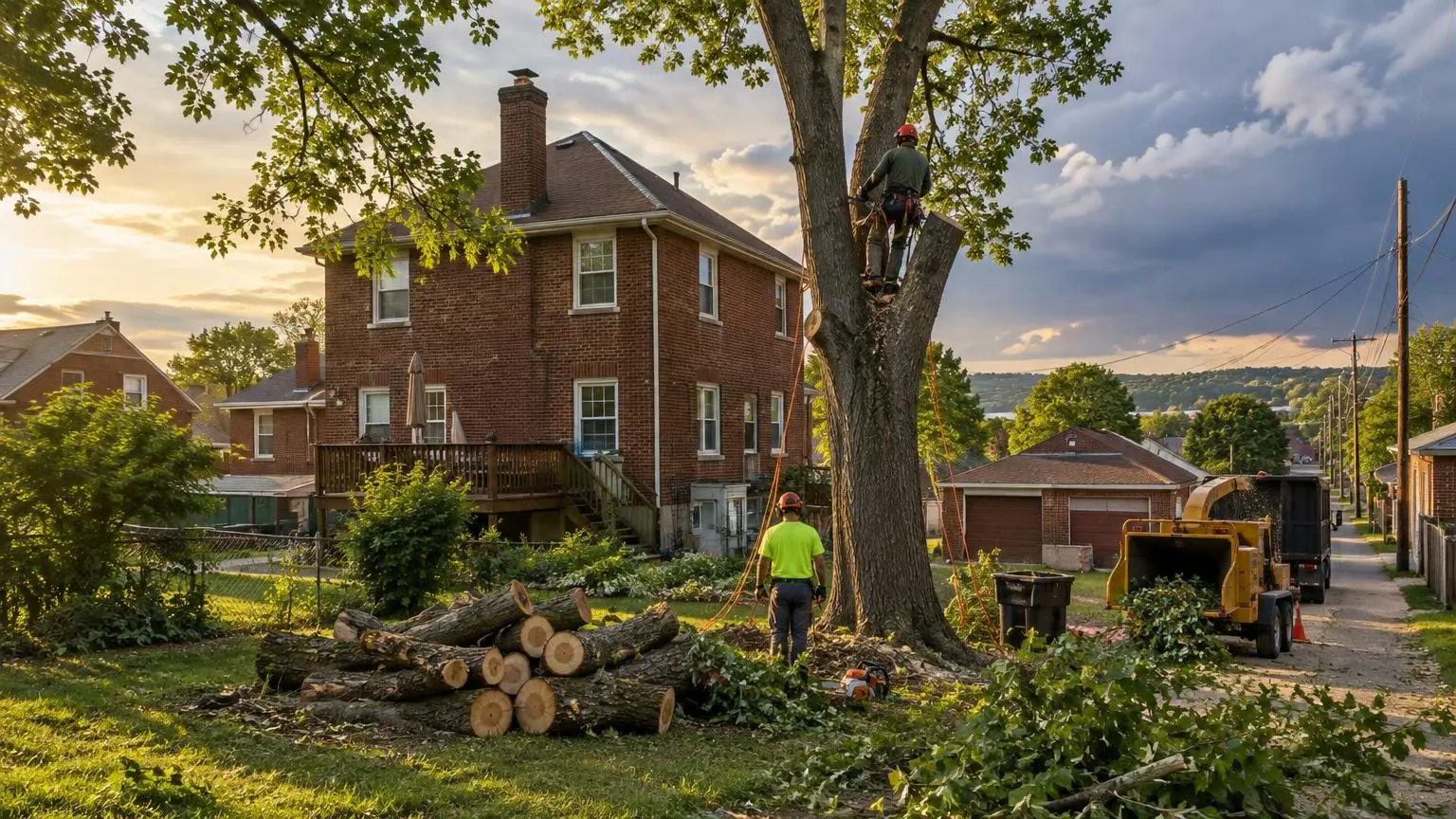
Tree Removal in Manchester mostly happens in the established subdivisions that fill the city between its commercial corridors. Manchester incorporated as a village in 1950 and became a fourth-class city in 1959. By the 2020 census it had 18,333 residents and 7,617 housing units on about 5 square miles, a vacancy rate of just 4.0 percent. That density, around 1,500 homes per square mile, means typical suburban lots: room for a few trees, but houses, fences and neighbors within reach of anything tall.
Why Manchester trees need attention now
Many of the trees in Manchester subdivisions were planted or left standing when the homes were built several decades ago. Since then, they have grown into mature trees, often bigger than anyone expected, and several common species have reached the point where they start causing problems:
- Ash killed or weakened by emerald ash borer, which reached nearby Ballwin in 2015
- Bradford pears with tight forks that split in wind and ice
- Pin oaks yellowing from iron chlorosis, common in the region's alkaline soils
- Silver maples and sweetgums with large limbs over roofs
- White pines and spruces crowded or dying back from the bottom
Storm season in west county
Most of the limb failures we see in Manchester come in late spring and summer thunderstorms, when trees are in full leaf and catching the most wind. Ice is the other hazard: a coat of ice on a Bradford pear or silver maple adds enormous weight, and weak forks give way. After either kind of storm, check your trees from a safe distance for hanging limbs, fresh cracks and new leans before you walk under them.
Name and history
Manchester was named by an English settler after Manchester, England. Its city hall is in the Lyceum Building, which is listed on the National Register of Historic Places. Most of the city lies in the Parkway School District, with a small southern portion in the Valley Park district, and it shares the character of the west county subdivisions that surround it.
What a removal involves here
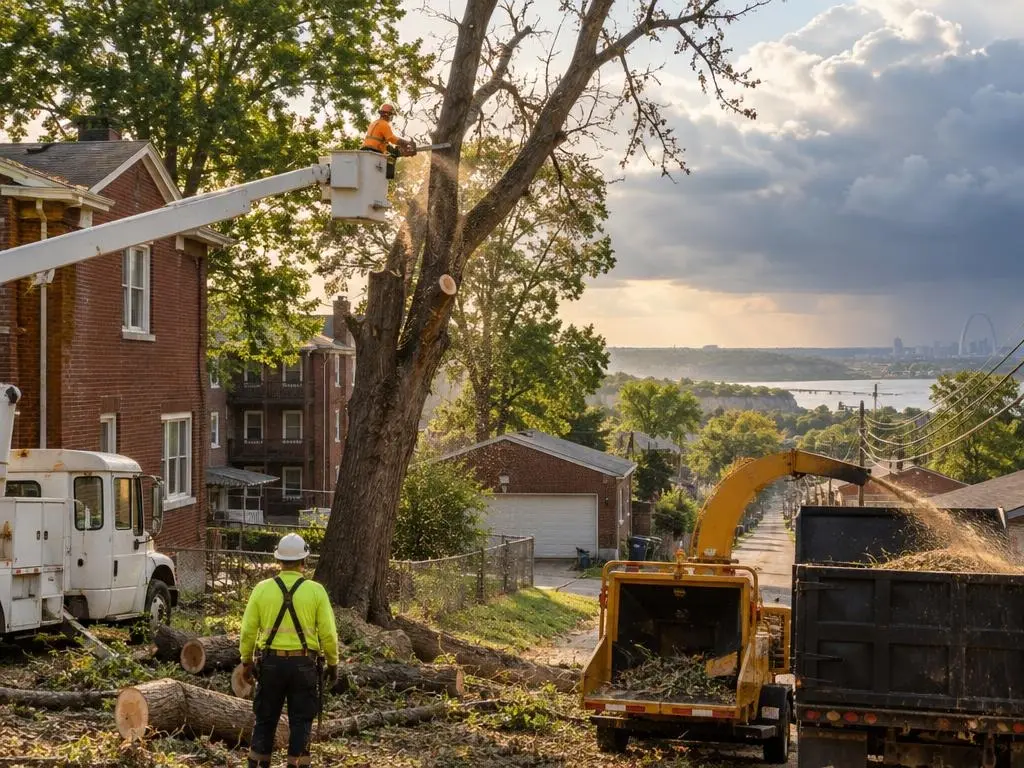
A typical Manchester removal is a medium or large tree in a back yard, with a fence, a deck or a shed nearby. The usual approach: 1. We look at access: gate width, slopes, soft ground, and where the chipper can sit 2. A climber or lift takes the crown down in pieces, lowered away from structures 3. The trunk is cut into rounds and removed 4. The stump is ground if you want, and the area is raked and cleaned
You get a written estimate before work starts that lists each of those pieces, so you know exactly what is included.
Contact
Call (314) 668-1571 or send the form with a short description. A photo of the tree helps. Get a free estimate
Manchester at a Glance
- Incorporation. Manchester incorporated as a village in 1950 and was reincorporated as a fourth-class city in 1959. Its City Hall is in the Lyceum Building, listed on the National Register of Historic Places.
- Suburban density. The 2020 census counted 18,333 residents and 7,617 housing units, with a 4.0 percent vacancy rate, on about 5 square miles, roughly 1,500 homes per square mile.
- Ash borer in the neighborhood. Neighboring Ballwin reports emerald ash borer arrived there in 2015, when the city had more than 2,000 ash trees in its right-of-way, so untreated ash in Manchester yards have been exposed for about a decade.
Manchester Questions
Our gate is narrow. Can you still remove the backyard tree?
Usually. Many jobs are done with the wood carried out by hand or in small loads, or with compact equipment that fits through a standard gate. We look at the gate when we come out to quote.
The tree is on the property line. Who pays for removal?
A tree whose trunk straddles the line is generally shared by both owners, and both should agree before it comes down. If the trunk is fully on one side, the owner on that side usually decides. Talk with your neighbor first, and we can quote the job for both of you.
Is a tree with mushrooms at the base dangerous?
It can be. Mushrooms or conks at the base often mean root or trunk decay, which you cannot see from outside. The tree should be checked, especially if it is near the house or a place where people gather.
How quickly can you come out after a storm?
It depends on how many calls come in at once after a big storm. Call (314) 668-1571 any time to leave the details, including whether anything is on the house or blocking a driveway, and we will prioritize the most dangerous situations first.
Tree Removal Near Manchester
- Tree Removal in St. Louis, MO
- Tree Removal in Kirkwood, MO
- Tree Removal in University City, MO
- Tree Removal in Clayton, MO
- Tree Removal in Webster Groves, MO
- Tree Removal in Ladue, MO
- Tree Removal in Chesterfield, MO
- Tree Removal in Ballwin, MO
- Tree Removal in Wildwood, MO
- Tree Removal in St. Peters, MO
- Tree Removal in Brentwood, MO
- Tree Removal in Richmond Heights, MO
- Tree Removal in Maplewood, MO
- Tree Removal in Glendale, MO
- Tree Removal in Creve Coeur, MO
- Tree Removal in Town and Country, MO
- Tree Removal in Sunset Hills, MO
- Tree Removal in Crestwood, MO
- Tree Removal in Des Peres, MO
- Tree Removal in Olivette, MO
- Tree Removal in Maryland Heights, MO
- Tree Removal in Bridgeton, MO
- Tree Removal in Florissant, MO
- Tree Removal in St. Charles, MO
- Tree Removal in O'Fallon, MO
- Tree Removal in Arnold, MO
- Tree Removal in Oakville, MO
- Tree Removal in Affton, MO
- Tree Removal in Edwardsville, IL