
Platted in 1794 as Marais des Liards, the Cottonwood Swamp
Tree Removal in Bridgeton, MO
A river town with big bottomland trees and a long history of storms.
- We come out and look before we price, anywhere in City of St. Louis and St. Louis County
- Each item on the estimate priced on its own
- We confirm where the wood goes before work begins
The Cottonwood Swamp, Two Centuries Later
Tree Removal in Bridgeton begins with a town named for its trees. Bridgeton was first platted in 1794 as Marais des Liards, which translates as Cottonwood Swamp, and was also called Village a Robert after Robert Owen, who held a Spanish land grant there. It received a state charter in 1843. The Missouri River still forms the city's northwestern boundary, and levee-protected floodplains along the river have supported much of its growth. Cottonwoods, silver maples, sycamores and box elders are still the trees of that low ground, and they are big, fast-growing and quick to break in a storm.
A city reshaped twice
Bridgeton has changed a great deal over the past three decades. Starting in 1995, an airport expansion built around a new runway, W-1W, led to the removal of about 2,000 homes, most notably in the Carrollton subdivision. Then, on the evening of April 22, 2011, the Good Friday EF4 tornado tracked through Bridgeton along with Maryland Heights, St. Ann and several other north county communities. The neighborhoods that remain have mature trees, many of them storm survivors, and a mix of older homes and newer development.
Today
The 2020 census counted 11,445 residents in Bridgeton, with 4,595 households and 5,088 housing units on about 14.6 square miles of land. With the airport next door and the river on one side, Bridgeton's residential neighborhoods each have their own character and their own mix of trees, from bottomland species near the river to planted shade trees on suburban streets.
Bottomland trees and what they do
- Cottonwoods grow very tall, quickly, and drop large limbs, especially in summer storms
- Silver maples develop heavy, weakly attached limbs and are prone to splitting
- Box elders are short-lived and break easily
- Sycamores are sturdier but get enormous and can shed big dead limbs
- Ash along creeks and yards have died from emerald ash borer
None of these need to be removed just for being what they are. But when one is in decline, damaged, or standing over a house, it is a priority.
Why big bottomland trees cost more to remove
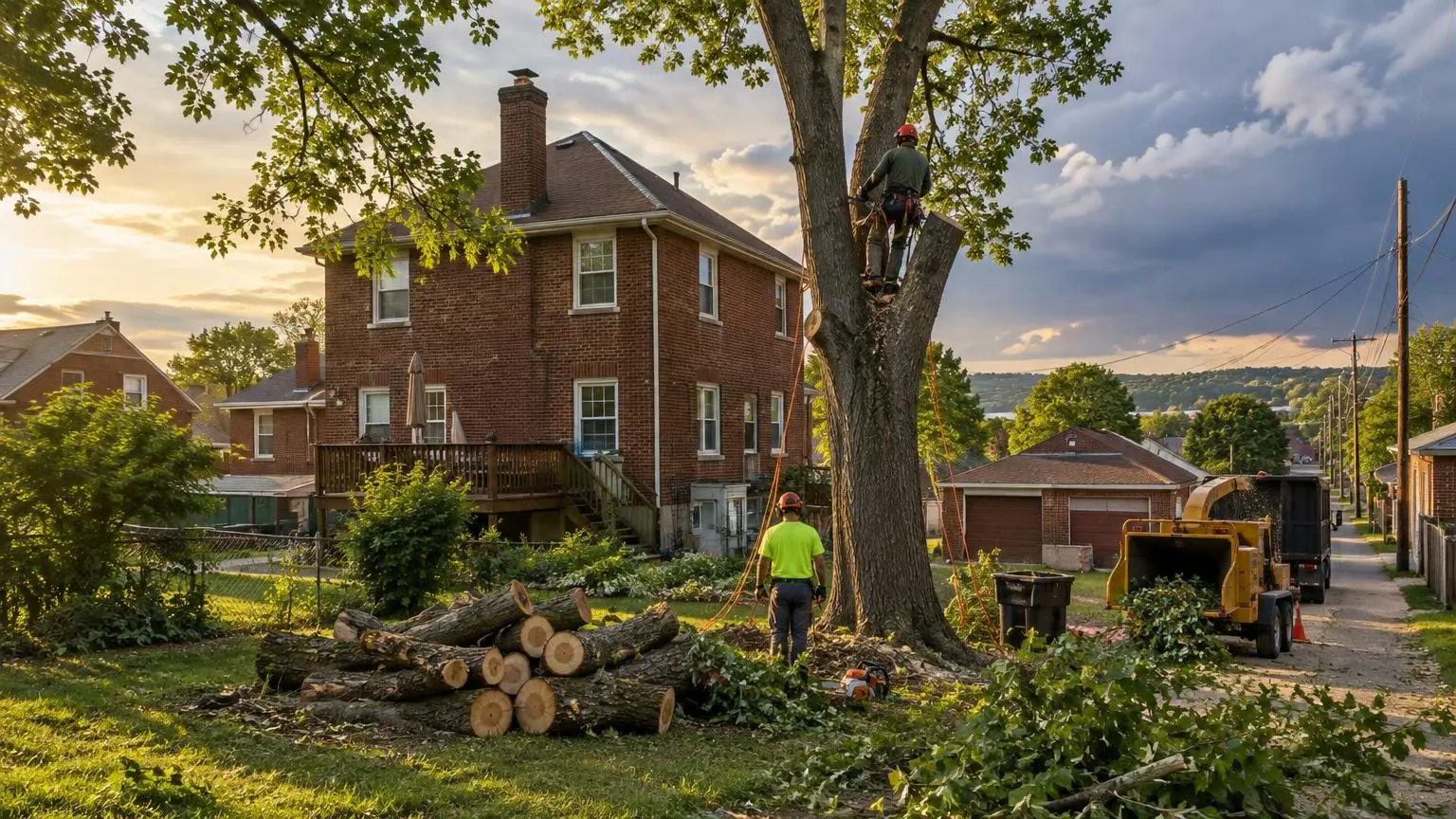
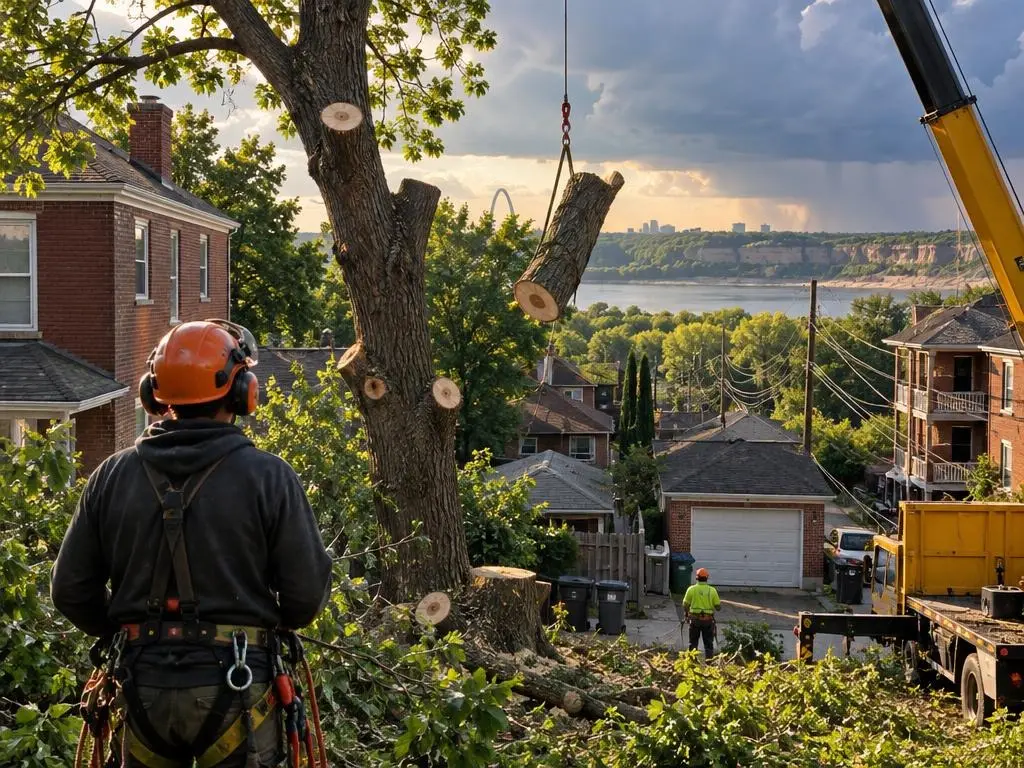
Tall, fast-growing trees like cottonwoods and silver maples often have wide, heavy crowns that spread over houses, garages and fences. Taking one down near structures means many pieces lowered on ropes, sometimes a lift or crane for the largest sections, and a lot of brush and wood to process. That is why we give a written estimate after seeing the tree, rather than quoting by phone. The estimate lists the removal, cleanup, hauling and any stump grinding separately.
After a storm
If a storm brings a tree down, stay away from any lines and call Ameren if wires are involved. Then call (314) 668-1571. We deal with hangers and anything on the house first, then clear driveways and yards. For planned removals, send the form and we will come out to quote. Get a free estimate
Bridgeton Background
- Named for cottonwoods. Bridgeton was first platted in 1794 as Marais des Liards, translated as Cottonwood Swamp, and received a state charter in 1843. The Missouri River forms its northwestern boundary.
- Airport buyouts. An airport expansion starting in 1995, built around new runway W-1W, led to the removal of about 2,000 homes in Bridgeton, most notably in the Carrollton subdivision.
- 2011 tornado. The April 22, 2011 EF4 tornado tracked 21.3 miles through Maryland Heights, Bridgeton, St. Ann, Berkeley, Ferguson and other communities, damaging about 2,700 structures across the metro.
- Population and housing. The 2020 census counted 11,445 residents, 4,595 households and 5,088 housing units, 9.7 percent vacant, on about 14.6 square miles of land.
Bridgeton Questions
Why do cottonwoods break so often?
They grow very fast, and fast growth makes weaker wood. They also get very tall, which exposes them to strong wind. In a storm, large limbs and even whole tops can snap off. A healthy cottonwood away from buildings can be fine; one over a house should be checked regularly.
Do you remove trees in low, wet yards?
Yes. Wet ground means we may climb and lower pieces instead of driving equipment across the yard, or use mats to spread the load. We plan around the ground conditions.
My tree survived the 2011 tornado. Is it still sound?
Many storm-survivor trees are fine, but some carry old wounds that have decayed over the years. Look for cavities, fungal growth, dead limbs and cracks. If you see any of those, have the tree inspected.
Can I keep some of the wood?
Sure. Tell us when we quote, and we will cut the trunk into lengths you can use for firewood and stack it where you want. Cottonwood burns fast and is not prized as firewood, but oak, ash and maple are.
Free Estimates in Bridgeton, MO
Free estimates across Bridgeton's neighborhoods.
Tree Removal Near Bridgeton
- Tree Removal in St. Louis, MO
- Tree Removal in Kirkwood, MO
- Tree Removal in University City, MO
- Tree Removal in Clayton, MO
- Tree Removal in Webster Groves, MO
- Tree Removal in Ladue, MO
- Tree Removal in Chesterfield, MO
- Tree Removal in Ballwin, MO
- Tree Removal in Wildwood, MO
- Tree Removal in St. Peters, MO
- Tree Removal in Brentwood, MO
- Tree Removal in Richmond Heights, MO
- Tree Removal in Maplewood, MO
- Tree Removal in Glendale, MO
- Tree Removal in Creve Coeur, MO
- Tree Removal in Town and Country, MO
- Tree Removal in Sunset Hills, MO
- Tree Removal in Crestwood, MO
- Tree Removal in Des Peres, MO
- Tree Removal in Manchester, MO
- Tree Removal in Olivette, MO
- Tree Removal in Maryland Heights, MO
- Tree Removal in Florissant, MO
- Tree Removal in St. Charles, MO
- Tree Removal in O'Fallon, MO
- Tree Removal in Arnold, MO
- Tree Removal in Oakville, MO
- Tree Removal in Affton, MO
- Tree Removal in Edwardsville, IL